Showing posts with label light. Show all posts

Thursday, 4 March 2010

Is there light at the end of the Tunnel?

Is there light at the end of the tunnel actually means that there is something which makes you believe that a difficult or unpleasant situation will end See freedictionary.

We have almost reached the end of the topic of light and shadow! Hopefully it hasn't been unpleasant!

Here are some of the chatterboxes which were great fun to make. They are also a great way to check our understanding of the unit.

Here is one of the chatterboxes opened up to show some of our questions and answers:


This is the template we used to make them. You can download another one here, but you need to sign up first.


Here are some questions we came up with and used in our chatterboxes:

Can light pass through opaque objects?
Is the smartboard screen a light source?
Is the moon a light source?
Do shadows from the sun look the same during the day?
When the object is close to the light source, is the shadow blurry?
Does glass make shadows?
What do you need to make a shadow?
Can metal reflect light?
Does gold reflect light?
Which word describes objects which are see through?
If something is translucent, can you see through it clearly?
Is a brick transparent?

Tuesday, 23 February 2010

Wow! Cave of Crystals!


Watch this incredible video of a cave in Mexico with 10m long crystals. Listen out for the narrator and how he describes some of them...a word we were learning about in science.

Tuesday, 19 January 2010

Shadows around school

Look at these shadows from school.
Can you tell what made them?
What shape are they?

Friday, 15 January 2010

Partial Solar Eclipse today - this afternoon - Bangkok

There is a partial solar eclipse due today.  This means that the moon will be travelling in between the sun (the big light source in the sky) and the earth (which is acting as a big "screen").

Safety: do not look directly at the sun.  See here for further safety information.
This is the best site I have found which shows when the eclipse is happening around the world and how much of an eclipse (how partial) it will be.


Here’s another link to solar eclipses on the BBC – looks like it is at 4:40???Conflicting information.


Here’s another animation.

We made some pinhole cameras.  Here is a copy of the instructions we used and some pictures of the cameras we made.  Unfortunately the images were not very clear, but the cameras WERE home made!

Thursday, 14 January 2010

Light and Shadows

Here are some questions we are going to investigate today:

What do you need to make a shadow?
Punn: You need a light source and an object
How do you make a shadow bigger?
Seb:you move the object closer to the light source.
How do you make a shadow smaller?
How do you make a shadow change shape?
How do you make a shadow more blurry?

Can light travel around corners?
Samuel:No but if you use a mirror and a light source, you can make a reflection of the light move around a corner.
Can you make coloured shadows?

Thursday, 7 January 2010

Where does light come from and what makes it change direction? Sources and reflection

Miss Kem and 3W scientists took some great photos today.

How many light sources can you see?

Which is the most reflective surface?

Can you recognise any of the places from our school?

How do we see things? Where does light come from?

Have a look at this link to find out where light comes from and how the rays of light travel.

Saturday, 29 August 2009

Wow a kaleidoscope of your very own!

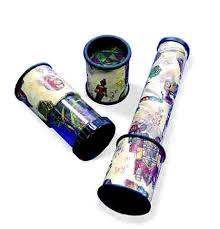
Before computers were in every home, when I grew up (well computers were starting to be invented when I was small) we had toys called Kaleidoscopes which looked like this:


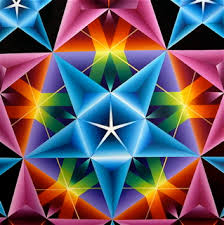
When you look through them they make amazing patterns by reflecting colour in mirrors.

The patterns looked like this:


I have just found a way to make the same kind of pattern. Look here and have a go. It's an easy to use website which makes all sorts of patterns.

Thursday, 21 May 2009

Athena's illuminating light and shadow facts

Follow this link to see Athena's light and shadow facts.

There are some great safety tips here. This powerpoint was edited by Tushar.

I tried to show it in the same way as Tushar's and Luc's powerpoint, using scribd, but there was a technical problem. Oh well.

Monday, 27 April 2009

Candles as clocks

Tushar did these two great pieces of research. It sounds like they could be true. What do you think?
If we could find another source which backs up the information, it would be even more credible (believable). Maybe you could research using a recent encyclopedia when we are in the library this week.
Well done!
Mr.Ben here is a lot of candle clock information A candle clock was one of the first methods of measuring the passage of time. From ancient Asia to the Dark Ages of Britain, people found ways to use candles to tell time. Though no one knows who invented the first candle clock, there is no doubt that they have been in use for centuries. Types of Candle Clocks Most candle clocks consisted of a 12-inch tall thin candle with markings that represented blocks of time. Common markings used were simple lines or numbers placed on both sides of the candle. As the candle burned past each marking, a person could have a sense of how much time was passing. Candle clocks were also used as timers. A person would stick a nail into the candle at the marking that represented the desired amount of time. Eventually the wax would melt and release the nail. The sound of the nail falling onto the candle plate alerted the person to the passage of time. Some candle clocks incorporated multiple candles and special holders. In multiple candle systems, candles of graduating sizes and markings indicated a specific period of time. As each candle burned, a person could measure time. Sometimes the candle holder or plate had panels with markings that assisted time keeping. Ancient China used candles and sticks of incense to measure time. Crude versions used sticks of different scents to measure time. Time passage was noted by a change in fragrance. Later versions of incense clocks combined sticks of incense with weights held by thread. When the stick of incense burned a thread, a weight was released and dropped on a plate. The sound of the weight on the plate indicated a passage of time. Read more: "Candle Clocks: An Early Method of Telling Time" - http://historicalresources.suite101.com/article.cfm/candle_clocks#ixzz3QOySWcOv&A I hope it is true,
Dear Mr.Ben,

I have more evidence that the sun spins:
Yes, the sun does spin, or rotate. Because it is a gas, it does not rotate like a solid. The sun actually spins faster at its equator than at its poles. The sun rotates once every 27 days at its equator, but only once every 31 days at its poles. We know this by watching the motion of sunspots and other solar features across the sun. The giant gas planets, Jupiter, Saturn, Uranus, and Neptune, also spin faster at their equators than at their poles.

On http://coolcosmos.ipac.caltech.edu/cosmic_kids/AskKids/sunspin.shtml

With special telescopes, scientists looking at our Sun notice that its features appear to move from one side to the other.

This is because our Sun actually spins. (Just like our planet Earth, only much more slowly.) It takes about 27 days for the Sun to make one complete rotation.

On
http://solar.physics.montana.edu/YPOP/Spotlight/Tour/tour06.html This link also has an animation of the sun spinning

from Tushar
Tushar, excellent research. Well done for including the source (the place you found the information). It would be even more reliable if we could find the same information from another source.
Well done,
Mr Ben


Friday, 24 April 2009

Unanswered science questions

Do you remember we came up with lots of "light and shadow" questions?

Can you answer any of them?

Send answers as comments, including where you found the answer(this is called a reference).
Who?
Who invented candles?
Who invented the light bulb?
What
What is light?
What are sunspots?
What is dark?
Where?
Where do shadows come from?
Where does light come from?
Where is the darkest place in the world/the universe?
When?
When was the light bulb/candle invented?
Why?
Why does light happen?
Why do we have shadows?
Why do we have rainbows?
Why are rainbows made of different colours?
Why don't the flames from the sun go out?
Why do shadows stretch?

Sunday, 19 April 2009

Light and Shadows - the earth in space

Why does the sun appear to move across the sky?
Why does the sun create shadows which change in length and direction during the day? Look here for a great animation. What time on the animation is the shadow the longest? Send answers as comments - remember to put your name if you use the answer anonymously option.

Usually I show it in class by using a bright light, a globe and a piece of blutack shaped like a person!

This website shows the earth rotating and you can change the month of the year to show how much sun each part of the earth gets.

This website is a great animation of the earth rotating, while it orbits the earth and while the moon orbits the earth.

To see how to make shadows bigger or smaller using an object, a screen and a light source, look here.

Friday, 20 March 2009

Light and shadow vocabulary

Here are the words which we are going to investigate this lesson:
transparent, translucent, opaque, reflective, reflection, light source, block light, shadow, sun, light, bright, dull, mirror, rainbow, sunspot, convex, concave, lens, prism (not prison), eye, pupil, iris, sclera, cornea, retina, screen, colours

Monday, 9 March 2009

Science - light and shadows

How can we find out answers to our questions? We thought of these ways:
Internet search and research
Reading books (non fiction) - e.g. encyclopedias, dictionaries,
TV(National Geographic, Discovery Science, Discovery) or DVD
Asking experts (scientists)
Radio
Test our ideas ourselves
Read a newspaper

We have a lot of questions!

If you find the answer, send it in!
Who?
Who invented candles?
Who invented the light bulb?
What?
What is light?
What are sunspots?
What is dark?
What makes the biggest shadow in the world/universe?
Where?
Where do shadows come from?
Where does light come from?
Where is the darkest place in the world/the universe?
When?
When was the light bulb/candle invented?
Why?
Why does light happen?
Why do we have shadows?
Why do we have rainbows?
Why are rainbows made of different colours?
Why can light be so bright and powerful?
Why don't the flames from the sun go out?
How?
How do you make electric light?
How can we measure light?
How is light made?
How hot (many degrees) is the sun?

Friday, 6 March 2009

Light and shadow

We started our topic on light and shadow today.

We went into the dark room (the guided reading book area) and took lots of shiny (reflective) things like mirrors, reflective gold paper, tinsel. We then turned off the lights (light sources). There were some lights that we could still see, like the computer screen, the LED lights on the A/C . We turned the computer off. We could not see the reflective materials because there was very little light to reflect.

We need a light source to see things.

We also talked about the pupil (a hole in your eye) and how light shines.

In the classroom we discovered that you can make a really short shadow but shining a torch (a light source) from directly above the pencil. This happens in our world at about midday when our biggest light source (the sun) is directly above us. In the late afternoon the sun is nearer the horizon and it casts a longer shadow.